

Aerial arts for beginners: all you need to know

Updated: Sep 21

Performing with an apparatus that hangs from an overhead surface to create powerful yet graceful movements can be called by several terms. It can be aerial dance, aerial acrobatics, aerial gymnastics, and aerial arts, which perfectly fits the bill.
Indeed, dancing while doing gymnastics and acrobatics in the air is a true expression of skill and imagination. That’s the very definition of art, btw. And mastery of each aerial apparatus (hammock, silks, hoop, and so on) is an art in itself.
Just like dance—its many forms include performing in the air—an aerial art is also a fitness activity and can even be considered as a sport. It’s actually a full-body workout done in a more interesting and even challenging, but ultimately, fun way.
This type of exercise is recommended by Maria Leila M. Doquenia, PTRP, MD, FPNA, a specialist in adult neurology, movement disorders, and clinical neurophysiology.

She explained to The Fitness Advocate that aerial arts, along with pole dancing, provide a "unique blend of strength, flexibility, and artistry while enhancing body awareness and confidence.” (For more of her recommendations, read here.)
Enjoying that health benefit was nowhere in my mind when I had my hands-on introduction to aerial arts in July 2013.
I just got curious that Polecats Manila, a pole dance studio located in Pasig City where I had taken a few classes some months prior, actually started offering aerial hoop and aerial silks.
At that time, I only knew about aerial arts from Cirque du Soleil.
I’m a huge fan of the circus company that was founded in 1984 by a pair of former street performers in the French-speaking Canadian province of Quebec. It eventually became the colossal entertainment enterprise known around the world today.
I can’t forget the first time I watched a Cirque du Soleil show—no less than one of its iconic touring productions, Quidam. It happened in early 2007 in, of all places, Dubai in the United Arab Emirates (UAE).

Well, I was then based in UAE's neighboring nation, Bahrain, so I didn’t have to fly all the way from home in the Philippines. The flight between the two Gulf states took a mere hour, and my entire trip included meetups with old friends.
Watching Quidam was awe-inspiring, not only because of the spectacular acts and death-defying stunts that exemplify Cirque du Soleil’s elevated and sophisticated approach to circus production.
For some reason, I saw and appreciated more the hard work the performers put into learning and perfecting their routines.
I could only imagine the countless tries and hours they spent rehearsing, for instance, hanging on a hoop using just the back of their neck. Or staying upside down with only the bridge of their feet supporting their bodies. And a lot more tricks and routines!
I felt the same stirring emotions watching the next Cirque du Soleil shows that came my way, finally at home.
Varekai was the first to wow the Filipino audience in 2011 and then, just a year later, Saltimbanco replicated the feat. (I skipped Toruk: The First Flight in 2017, the last time the circus company had a show in Manila.)

Who would’ve thought that in 2013, I'd experience firsthand getting on a hoop and silks?
Apparently, aerial arts for fitness and as a hobby had been gaining traction for many years in North America, Continental Europe, and some parts of Asia. It eventually found its way in the Philippines, following the establishment of the pole dance community in the country.
In my first-ever aerial arts class at Polecats Manila, I learned the fundamentals of hoop and silks.
I was taught how to mount the hoop (also called lyra) via hocks hang. Nailed it, thanks to a strong core that was born out of consistent yoga practice. Then on to sitting safely inside the apparatus and doing the beginner trick called the man in the moon.

For silks, I was only guided how to sit and lie down on the two pieces of long fabric that had been looped together. This particular aerial art, as I would discover later on, requires more sessions to really get it.
I went home feeling so exhilarated that I decided to create an Instagram account. The app was barely three years old then and just starting to attract attention, so I deemed it as the perfect platform to share my photos.
My very first Instagram post, dated July 11, 2013, marked my first stab at lyra with the caption, “New fascination: aerial hoop.”
Shortly after, I posted my photo on aerial silks—yep, no carousel option yet! The caption pretty much summed everything up as a “novel experience.”

I thought that was it for me, just a one-time thing to satisfy my curiosity. But the following year, I found myself in Polecats again to give aerial hoop another go.
By 2016, I discovered other venues where I could take classes in hoop. I checked out the pole and aerial arts studios in the cities of Pasig, Quezon, and Makati, as well as a gym in Marikina City that also offered ballet and hoop.
My hoop teacher in the Marikina City gym—her name is Cha San Juan—couldn’t demo to her students how to spin on the apparatus because the venue lacked the mechanism for it.
So, she suggested to me to take classes in Pole Dolls Dance Studio (now defunct), to get the full experience of hoop and other apparatuses.

That happened around March or April 2017, when Pole Dolls was in the thick of preparations for its second annual recital show in June. Next thing I knew, I had signed up for the student showcase, titled Cre20, and got a slot in Teacher JL Bolina's aerial hoop beginner class.
No turning back from thereon.
I continued taking hoop classes weekly, and when Pole Dolls moved to a location in Mandaluyong City that was just a walking distance from my then-workplace, I had the convenience to hit the studio more often.
As a result, I got to take classes in other apparatuses and expanded my repertoire in succeeding recital shows: Nev3rland in 2018 (hoop, hammock, plus pole groove) and Director's Cut in 2019 (hoop, silks).
Then, the pandemic happened in early 2020. I couldn't do aerial arts for the next two years, and so, I regressed to almost beginner level.
Not the one to easily give up, I began training again at the onset of 2023. How?
I made it a point to attend the Sunday hoop class of one of my first teachers, Nesh Zamora, who by then, had cofounded Elite Aerial Arts, a studio that also offers classes in pole, dance, and yoga.
Then, I joined Elite’s recital show in June 2023, titled Decades, as a performer in one of Nesh’s hoop classes. That's when I realized I still had the chops and fervor for aerial arts.
And I just couldn't stop!
The following year, in May 2024, I joined not one, but two recital classes, both under Nesh. Aside from my fave hoop, I signed up in mixed aerials (cube + lyra pole).
I also joined Elite's May 2025 recital show, Lost and Found, but opted to perform in teacher Eiza Chua's aerial silks mixed-levels class.
Before that show took off in eight days, I was in PxA Dance Studio's maiden recital show, Villains. I performed in teacher Finnele Quintano's hoop class and, as an aside, in teacher Tetin Arcega-Santos's pole spin class.

In May 2026, I joined Elite's recital show, for the fourth time, because I was drawn to teacher Ian Milan's aerial straps class.
And that's my aerial arts journey…so far! (Read the full story here.)
These days, I ceaselessly enjoy attending aerial arts classes at different studios to learn from different teachers. I also look forward to trying out other apparatuses and their amalgamation.
Where to start in aerial arts?
Aerial arts, along with pole dance, and the community have grown by leaps and bounds in the past decade.
There are more venues now that offer classes, either as the main line of business such as pole and aerial studios, or as an additional service in gyms and other fitness hubs.
In Metro Manila alone, more than a dozen studios have built a solid following while attracting new students.
There are also a few more studios on the outskirts (Rizal, Bulacan) and beyond (La Union, Baguio, Cebu, Bohol, Negros Occidental, Davao Region, Zamboanga Peninsula).
Whenever I’m asked for recommendations, usually by those based in Metro Manila, I always suggest the ones nearest their residence or workplace. The proximity to the location will give them an extra push to show up in their first class.
Here's a rundown on studios that offer classes in aerial arts:
In Pasig City, there are industry leaders Polecats Manila (established in 2009) and Beast House Philippines. In between, though already located in Mandaluyong City, there’s The Stvdio, which is a rebirth of sorts of Pole Dolls Dance Studio.
Makati City is home to Fame Artists’ Studio, also considered an OG in the community, and to Good Girls Club.
Quezon City’s list is headed by the very popular Elite Aerial Arts. It also includes Stardanz Fitness Studio, Misfit Pole and Aerial Dance Studio, and Studio B.E.D. (which stands for Body Endorphins Dance).
There’s one studio each in the cities of Marikina (The Dance Lab), Manila (Sora Studio), and Caloocan (The Pole Studio).
Down south, there are two in Las Piñas (Aphrobabe Dance Studio, Core Aerial Dance Studio) and one in Parañaque (Chrome Divas).

Outside the capital region, there are a few more studios in the country's largest island group, Luzon.
The province of Rizal has four: Beast House East and PxA Dance Studio, both in Antipolo City, and Dance with Abby Grace (DAG) Studio and The Upside Aerial & Pole Studio, both in Cainta town.
Bulacan province has one: Defy Cirque in Santa Maria town.
Also in Luzon, there's one each in
La Union (Wilab Pole & Aerial Dance Studio) and Baguio City (Eudaimonia Wellness Refinery).
Plus in the two other island groups: Visayas has studios found in Cebu (Fit & Fab Pole Fitness Studio, Pole Sphinx), Bohol (Bohol Pole & Aerial Studio), and Negros Occidental (Mandala Centering Place Bacolod).
Mindanao has studios located in the Davao Region (Aero Baila Fitness, Evolve Pole Fitness and Aerial Arts Studio, Poise Davao City, Poise Panabo City), and in the Zamboanga Peninsula (Bailar Pole and Aerial Fitness Studio).
There could be more. The Fitness Advocate will update this page every now and then.
All studios mentioned have social media accounts, where info on schedule of classes and how to book are posted. Many of them are also found on the ClassPass subscription service app.
Choose your apparatus
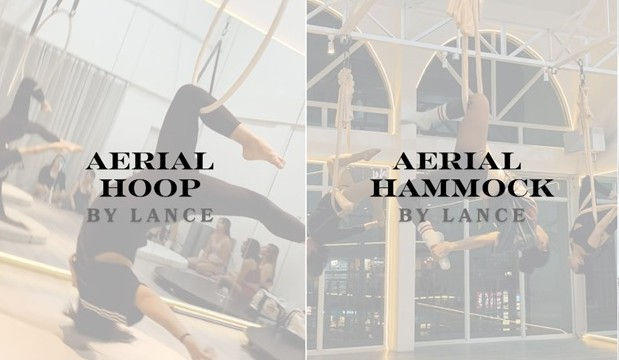
Hoop, hammock, and silks are the most popular aerial arts in the Philippines. Hoop and hammock are also widely considered the gateway to the discipline, and thus offered in all pole and aerial arts studios.
An aerial hoop, or lyra, is a lot like hula hoop—you know, the children’s plaything twirled around the waist, limbs, or neck that has evolved into a tool for fitness and even dance.
This type of hoop, though, hangs from the ceiling and is made of metal. So, it will not break when perched on and while doing tricks and spinning.
An aerial hammock, also called aerial sling, has similarities with aerial yoga. Both have the soft, low-stretch fabric that's suspended from the ceiling to form a loop, where practitioners mount to do exercises for strength and flexibility.
But aerialists take further steps to create shapes and stunts for a dance performance.
On the other hand, classes in silks are not readily available in all studios. I’d say, based on my experience and supported by other aerialists’ observation, this apparatus demands more upper-body strength to learn.
Aerial silks, also called tissu (the French word for fabric), is the term for the apparatus made of two pieces of fabric, typically the same type but longer than the one used in hammock.
The pair of fabric can be tied together to create a loop, which will then provide an easy access to doing tricks. But the norm is to climb using one or both the tissues.
Then, the aerialist will carry out a set of moves to end up in a secure position that facilitates a safe performance of tricks and stunts, or in preparation for a drop.
Of course, you can always choose silks for your initial foray into aerial arts. Who knows, you may actually enjoy or get challenged enough to keep showing up in class, then over time, you'll gain more and more strength.
Some aerialists have actually taken this route, and, as a result, they had an easier time tackling next hoop, hammock, and other apparatuses that, by the way, you can also try first.
These not-so-common aerial arts include moon, straps, trapeze, loops, cube—which I have all tried—then, spiral, umbrella, and surely more! Regular and popup classes are offered in select studios.
Moreover, there are the mixed aerials, which combine two (or maybe even more) aerial apparatuses. It can also be the category for the amalgamation of aerial arts and pole.
The ones I've tried are hoop x loop, lyra pole, flying pole, silki pole, and hoop x strap. Wonder what's next...Any reco?
What to expect in an aerial arts class?

Having a dance background or doing yoga and other fitness activities is an advantage, but not a requirement in starting your journey in aerial arts. You just have to be willing to learn, or at least curious to try something new.
Yup, there are no restrictions on age and weight for adults. Nope, the apparatus will not break because you’re too heavy nor your bones will break because you’re too old (as proven by this Gen Xer).
But, if you have health concerns and recent injuries, you have to ask for advice or clearance from your doctor.
Now, you’re ready to book your first class!
Pro tip: Take an intro class either in general aerial arts or in a specific apparatus (hoop, hammock, silks). This will make you feel more at ease, knowing that everybody in class is, if not a first-timer, a complete newbie.
There's a catch, though. Looking for an intro class with a specific schedule and location in mind can be a challenge as it’s not available in many studios. One solution is to opt for a private class that you can book at your convenience.
For a regular group class, your next option is the one designed for beginners, whether attending for the first time or have some experience in aerial arts.
Another option is called either open level or mixed-levels class, which accommodates students of varying degrees of skills.

Whatever class you end up in, it typically begins with the teacher introducing themself and then ask the newcomers for their names and fitness background.
The teacher will also ask about students’ recent injuries that may impede bodily movement. This way, they can make modifications in their lesson plan.
Then on to the warmup exercises that will help prepare the body for a workout. It’s followed by a set of conditioning drills using the apparatus to target specific muscle groups pertinent in performing the tricks.
The students are grouped into first-timers, beginners, and if applicable, intermediate and advanced. Each group will be assigned a station with at least one dedicated apparatus.
First-timers are taught the fundamentals; the beginners, basic tricks; and the inter-advanced, a combination of tricks.
The teacher will demo to each group of students and then explain, step-by-step, how everything is done.

Next, the students will take turns on the apparatus while following instructions from the teacher. They also get an extra push from the teacher until they learn the tricks and also additional time to practice on their own.
To ensure safety, a crash mat is placed under each apparatus. The teacher also keeps an eye on the students, especially the first-timers, while the senior ones spot one another.
The last part of the class is for the students to showcase what they just learned. This could be daunting for first-timers and beginners, but no judgment here.
Take heart in knowing that the inter-advanced students—even the teachers—were once first-timers who returned to class as beginners and kept on showing up until they reached the level of competency and confidence that they now have.
You can get there, too, and as you appreciate each step of your journey, you will also cheer for the ones who are just starting theirs.
Find your tribe through aerial arts
For those who turn up in class, the studio is not only a place to learn about and train in aerial arts for either fitness or recreation. It’s also a safe and happy place they can share with kindred spirits.
Bonds are especially built during recital season as groupmates rehearse together for several weeks to bring their teachers' dream choreography to life on stage.
Take it from Fechie Briguel, Claudine Enduma, and Rafael—aerialists with varying levels of experience and one constant passion.
Fechie Briguel, aerial arts teacher since 2017: “Just show up”

Dance has always been an integral part of Fechie Briguel’s life, not only as an artform but also as a fitness activity.
Her early training in various genres, such as ballet, contemporary, jazz, and modern dance built her physical strength and flexibility, as well as body awareness.
She then sharpened those tools especially in the last 10 years that she's been performing, teaching, and coaching aerial arts. Those tasks are "very physical," she said, and keep her "active daily."
"Right now, most of my fitness comes from dancing and training in the air," she pointed out to The Fitness Advocate.
"It's also how I stay strong as a single mom of three."
Fechie, who's fondly called Teach Fechie by her students, recalled the time she learned about aerial arts.
It occured during a high point in her career as a professional dancer: reaching the senior- member status at Airdance, which is recognized as one of the Philippines’ pioneering companies in contemporary dance and aerial arts.

In hindsight, she noted that the transition to aerial dance felt natural for her because it’s just as “expressive and physical” as the other genres that she’d been performing for a long time.
“I got curious about the combination of strength and artistry in the air,” she pointed out.
The dancer-turned-aerialist first tried silks and hoop because they were already part of Airdance’s performance menu for corporate shows and events.
Soon, she mastered those apparatuses and realized “na gusto kong i-share 'yung knowledge and talent na meron ako.”
Fechie started teaching hoop and silks in 2017, when Airdance was having its summer workshops. She enjoyed the experience and proved to be exceptional at her newfound calling.
As her involvement in aerial arts deepened, she explored another apparatus during the pandemic in 2020, and it was aerial hammock.
“Each one has its own challenge, especially the transition and routines,” said Fechie about the three apparatuses.

She noted that while hoop and hammock are two completely different apparatuses, they have the same poses. Both are “great for beginners and beautiful in the air with the spin,” as explained by the one who confesses to “love spinning.”
Silks, on the other hand, proved to be “very challenging” for Fechie “because there's no support unlike in hoop and hammock." But at the same time, it’s where she gets “the biggest achievement” as “every climb and drop feels so amazing and empowering.”
The 37-year-old dancer, choreographer, and teacher/coach of aerial arts from Caloocan City then looked back on her journey and shared these takeaways:
“As a student, I learned patience and trust in my own body. It's not instant progress over perfection.
“As a teacher, I learned that every student has different fears. Natutunan ko rin na kaya kong maging strong, hindi lang physically, mentally and emotionally. Lalo na as a single mom.”
Aside from being strong and patient, Fechie is admired as a technically polished performer who instills the same values in her students. She also knows how to simultaneously encourage and challenge them to keep going and growing.

Her journey continues as other apparatuses beckon, such as aerial pole and aerial straps. She said she expects them to “require a lot of strength and they feel like the next level of challenge.”
Fechie has this to say to those who would like to embark on their own journey in aerial arts:
“We all started at zero. No one is strong right away. No one is flexible right away. Ang aerial arts, hindi lang para sa dancers o sa payat lang. Para siya sa kahit sinong willing matuto.
“There's no judgment. Just start with the basics, one step at a time. Strength and confidence are built over time. Just show up, and I'll meet you where you are.”
Claudine Enduma, aerial arts student since 2023: “I discovered the strength and grace that my body can do”
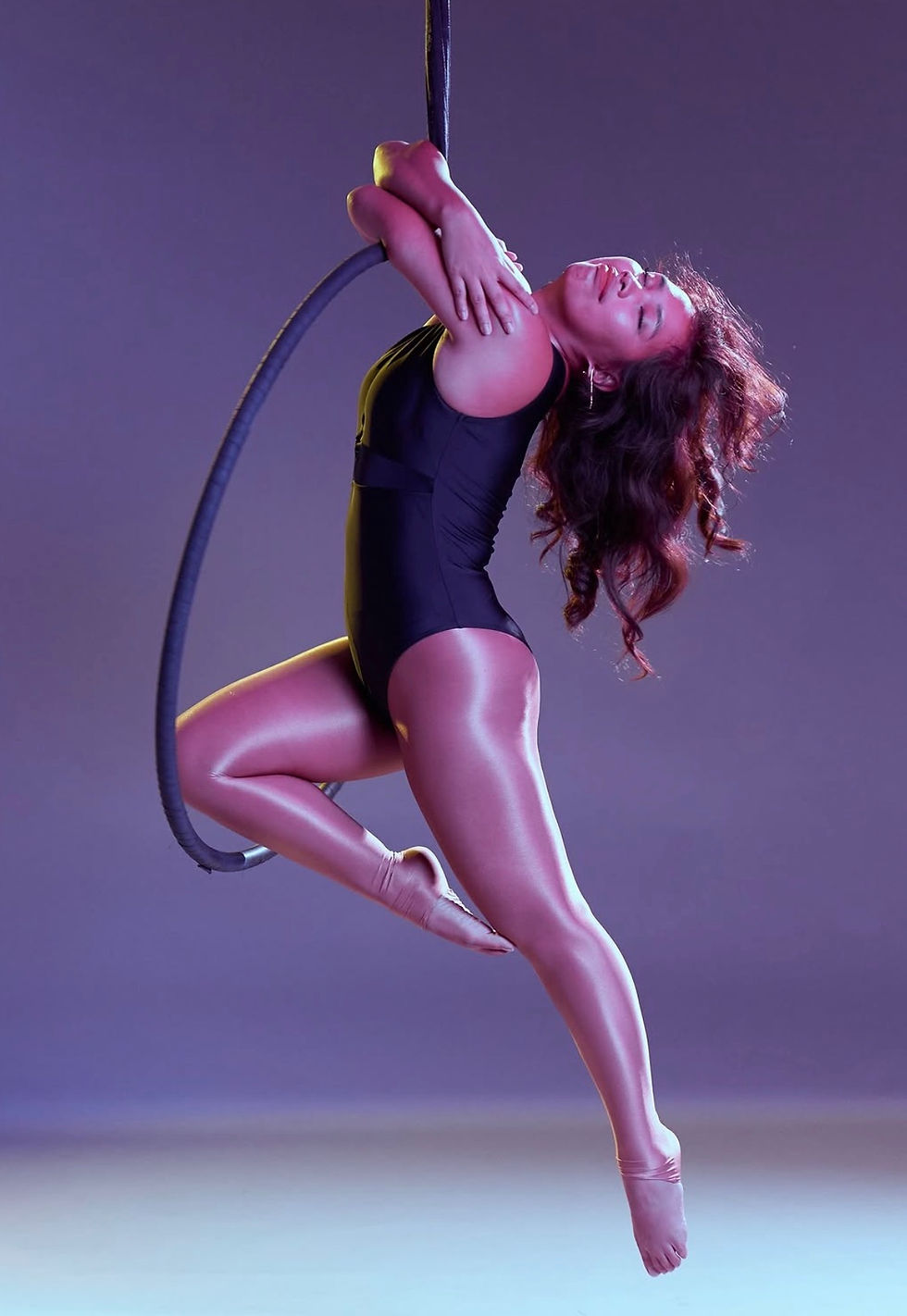
As someone who professes to “really value good health,” Claudine Enduma stays active by trying one fitness activity to another. It had been walking, working out in the gym, boxing, yoga, muay Thai, marksmanship, joining a dragon boat team, and so on.
The 30ish professional, who works as an urban planner, constantly seeks variety in enjoying recreation that she’s often described by her best friends as “a woman with lots of hobbies.”
Her explanation: “I’m always that person who is not afraid of trying new things, especially fitness activities, even if I’m alone.”
“Currently, I am in love with aerial arts,” she told The Fitness Advocate, explaining that she initially attended a few classes in 2019 before taking it up again in 2023, this time at the Elite Aerial Arts studio in Quezon City.

Claudine is so committed to her newfound passion that she’s become a familiar and friendly presence at the studio where she’s found the “beautiful and supportive community behind my wonderful aerial journey.”
She diligently attends classes in her favorite apparatus, hoop, as well as in hammock, and occasionally, in dance like belly dance.
“I do practice 2 to 3 times a week,” she said, “or more if there are random invites or budols from aerial friends.”
She has also created an Instagram account, with the handle @aerialcloud, and calls it her aerial art diary.
“I love the confidence and stability I find whenever I’m on aerial hoop, while aerial hammock brings out a more sensitive and feminine side of me,” Claudine remarked on what captivated her heart.
She expounded on aerial hammock: “The fabric reacts so quickly to subtle movements, it encourages me to have greater awareness while creating a more fluid and graceful flow.”

Through aerial arts, she pointed out, she discovered the strength and grace that her body could do—something that “my younger self would be so surprised.”
Digging deeper, she shared a more personal reason why she’s fallen in love with aerial arts: “Somehow, it became part of my healing journey. Every time I fly, it feels like it’s also healing the inner child in me who grew up way too fast.”
That love reached peak levels during the three times Claudine joined Elite Aerial Arts’ annual recital, namely Lost and Found (2023), 8motions (2024), and Twisted Tales (2026).
“The recital also gives me a unique experience and discovery as I perform the art that I love not only for the audience, but also for myself,” she said.

What’s next for the one who’s not afraid to try a new fitness activity?
“I’d love to try sultry pole,” she replied in a playful tone, “since Claudia, the sultry name my aerialist friends and teachers gave me, is gaining more popularity.”
She also expressed willingness to get on aerial straps and, to some extent, silks “to challenge myself and continue growing in my aerial journey.”
As for those who are curious, but consumed by self-doubt to try aerial arts, Claudine stressed that one need not wait to become strong and flexible to give it a go.
“The teachers will meet you exactly where you are in your journey,” she said. “You become stronger, more graceful, and more flexible as you practice. All you gotta do is take that first class.”
Rafael, aerial arts student since 2025: “I’d recommend aerial as a sport and a hobby for people who’d want to improve their strength while also building on their flexibility”

This is how Rafael (nicknamed Raf, last name withheld for some privacy) describes himself: “doctor by morning, gym rat in the afternoon, aerialist in the evening.”
Allotting a third of his day to fitness activities underscores how he values work-life balance and having an active lifestyle.
“I’ve been into fitness since as early as elementary,” he recalled to The Fitness Advocate. “I’ve been involved in sports as young as 9 years old.”
Raf dabbled into swimming, soccer, badminton, a bit of basketball—the last item didn’t really pique his interest, anyway—before considering karate as his first official sport.
“When I entered college, weightlifting and bodybuilding had been my entry into the much broader fitness community,” he said, referring to his staple exercise routine until he got into and graduated from med school.
Then, he plateaued, as he was getting “more stagnant” with his gym workouts. He started looking for other fitness activities to complement the bodybuilding exercises he’d been religiously doing.

Around November 2025, Raf was prodded by a friend to check out the classes at Elite Aerial Arts.
He knew he didn’t have the flexibility and background in the performing arts, and he thought it would be “strange that a male bodybuilder would waltz right in a studio to try aerial.”
But that's exactly what he did one day in the hammock class of Nesh Zamora, who he now considers as his first-ever instructor in aerial arts.
“At first, I thought it was just going to be a one-time thing because I’ll get back to bodybuilding still,” he remembered what was going through his mind.
His resolve quicky dissolved when the instructor lovingly called Teach Nesh performed an aerial hammock trick that prompted him to ask, “How’d you do it?”
Without skipping a beat and thinking on her feet (with pointed toes!), Teach Nesh teasingly replied, “Attend ka sa susunod na class.” She got him hook, line, and sinker.
“And that’s how my aerial journey snowballed,” Raf said, amused and pleased at the memory of falling for the teacher's trick, which turned out to be a treat, after all.
Aside from hammock, he explored silks, hoop, mixed aerials, and briefly, pole dance. He also became a regular attendee in Elite’s conditioning class called Power Stretch because, as he put it, “I was not a flexible person in any way, shape, or form.”

The newbie aerialist got so into his new fitness activity that, at one point, he contemplated on attending four classes in one day. But wisely accepted it’s “not recommended” to do for him or anybody else.
Raf looked back at that phase with fondness, “I think my enjoyment reached to a level that Teach Nesh jokingly remarked, ‘Bawal nang papasukin si Raf dito,’ given how often I’d drop by the studio to attend classes.”
Small wonder then that he progressed much faster than a typical newbie would in six months. In such a short time, he acquired the skills and confidence to perform in four of Elite’s recital classes for the 2026 edition of its annual student showcase.
He admitted it was not an easy feat, yet he came out a winner in each of his number in the recital, titled Twisted Tales. He was a delight to watch while performing on hammock, hoop, silks, and mixed aerials.
“Another box ticked off my to-do list,” he said of his rousing recital debut.
Some changes in his routine are in order, though: “Right now, I’m considering attending less classes because I’m pivoting towards competing in my first bodybuilding competition, hopefully this year.”
He added, “I did however decide about the apparatus that I would be focusing on because they just complement my build. That does not mean I’ll not be attending aerial classes, I’m just trimming down my weekly presence.”
His closing thought: “I’d recommend aerial as a sport and a hobby for people who’d want to improve their strength while also building on their flexibility. It’s a perfect combination of power and grace packaged in an aesthetic art form.”


Comments